
weavevault.app and Vaulty are both private photo vault apps for Android and iOS, but if you're searching for "Vaulty Stocks app" right now, the product you remember by that name doesn't exist as a separate download anymore. Vaulty Stocks — the vault that looked like a stock market app until you unlocked it — was unpublished from the Google Play Store on March 13, 2022, and its functionality was folded into the main Vaulty app. Vaulty's own help center confirms it in one line: Vaulty Stocks "is no longer offered or supported as a separate app."
That leaves you choosing between weavevault.app and Vaulty (the app Vaulty Stocks was merged into), and the honest way to make that choice is on three things you can check for yourself: what each app asks you to hand over before you can use it, what each app tells you about how your files are actually encrypted, and how each app prices access to your own backups. weavevault.app opens with no account of any kind — no email, no profile — and encrypts every vault with AES-256-GCM under a key derived from your unlock pattern. Vaulty requires an email address to use its backup features, and its published materials describe locking with a PIN, password, or biometric without naming an encryption cipher.
This page compares the two on those dimensions, plus pricing structure — and it also gives Vaulty full credit where it earns it, including features weavevault.app doesn't currently offer.
| Feature | weavevault.app | Vaulty Stocks / Vaulty | |
|---|---|---|---|
| Still available as a standalone app | ✓ actively maintained | ✗ discontinued — unpublished from Google Play March 13, 2022 | Vaulty's own help page, "What happened to Vaulty Stocks?" (vaultyapp.com): "Vaulty Stocks is no longer offered or supported as a separate app." |
| No account required | ✓ no email, no profile, no sign-up, on free or Pro | ✗ App Store privacy label lists email address and user ID collected, linked to identity | Apple App Store listing for Vaulty (id1616386868), App Privacy section. |
| Encryption protocol publicly documented | ✓ AES-256-GCM per file, Argon2id (RFC 9106) key derivation, published on /security | Not published — no cipher or key-derivation function is named on vaultyapp.com or its App Store listing | vaultyapp.com marketing pages and the Apple App Store listing describe only PIN/password/biometric locking; neither names an encryption algorithm. |
| One-time lifetime purchase option | ✓ available alongside monthly and annual subscriptions | ✗ App Store listing shows only recurring subscriptions (weekly $7.99 up to yearly $99.99, plus separate premium tiers) | Apple App Store in-app purchase list for Vaulty. |
| Behavior on an unrecognized unlock code | Any unrecognized pattern silently opens a fresh empty vault — nothing extra to configure | Partial — requires deliberately setting up a separate Decoy PIN that opens an empty gallery | weavevault.app /security; Vaulty App Store listing's description of its decoy PIN feature. |
| Photographs whoever enters the wrong code | Not a published feature | ✓ Vaulty's "mugshot" feature uses the front camera to catch failed unlock attempts | vaultyapp.com: "If someone tries to snoop in your vault and enters the wrong password, Vaulty will catch a picture of them." Included as an honest point in the competitor's favor. |
What actually happened to Vaulty Stocks
If you used Vaulty Stocks and it disappeared from your phone or from the Play Store, you weren't imagining it. Vaulty Stocks — the private photo vault that looked like a stock market app until you unlocked it — was unpublished from the Google Play Store on March 13, 2022. It wasn't pulled for a policy violation as far as any public record shows; it was merged into the main Vaulty app, which absorbed its vault functionality going forward.
Vaulty's own help center says this plainly, on a page titled "What happened to Vaulty Stocks?": "Vaulty Stocks is no longer offered or supported as a separate app." If you're still running an old copy of Vaulty Stocks, it will not receive updates or support, and there's no path to reinstall it from Google Play today.
That means the real comparison isn't weavevault.app vs. Vaulty Stocks — it's weavevault.app vs. Vaulty, the app your old vault was rolled into. Vaulty carried the vault concept forward but changed the terms: it now asks for an email address and, for backup, a subscription. Every section below compares weavevault.app against that current Vaulty, not against the discontinued app you may remember.
Accounts and data collection
The first thing either app asks of you is different in kind, not just degree. weavevault.app has no account system at all — no email, no profile, no sign-up screen — on either the free tier or Pro. You set an unlock pattern and you're in; there's nothing to register.
Vaulty's own Apple App Store listing discloses a different model in its App Privacy section: the app collects an email address and a user ID, and both are linked to your identity. That's not a rumor or a third-party inference — it's Vaulty's own self-reported disclosure, the same kind every app makes on the App Store.
Whether that distinction matters to you depends on what you're protecting. An account with an email address tied to it is one more record that exists somewhere — one more thing that could be exposed in a breach or simply requested from whoever runs the service. weavevault.app's zero-account model means there's no email or user ID to disclose in the first place, because none is collected, on free or Pro.
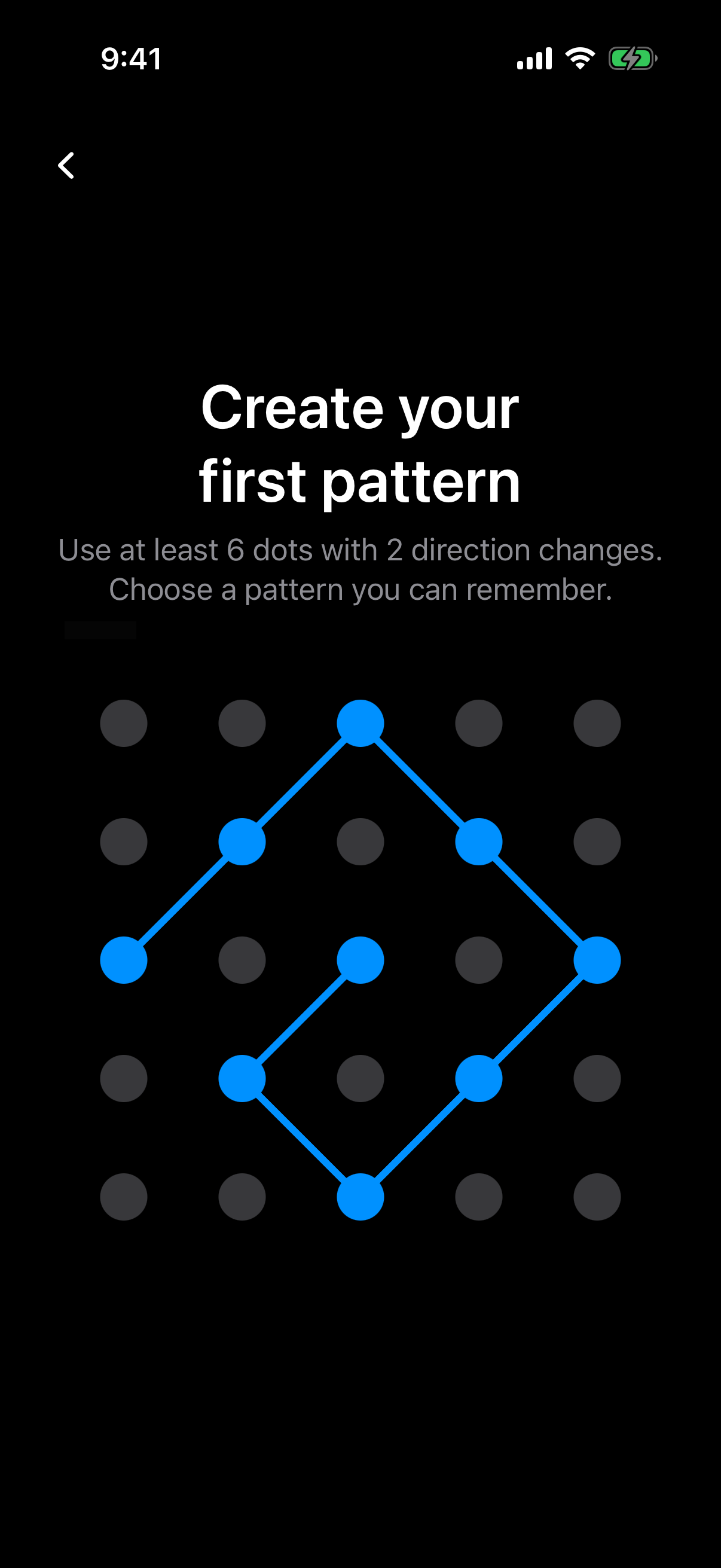
Setup starts by drawing a pattern; there is no sign-up screen or email field.
What each app tells you about its encryption
weavevault.app publishes the specifics of how it protects your files: each file is encrypted with AES-256-GCM, using a fresh 96-bit nonce and a 128-bit authentication tag per file. The key that encrypts your files is itself protected by a key-encryption key derived from your unlock pattern using Argon2id, the memory-hard key-derivation function specified in RFC 9106, at t=3, m=64 MiB, p=1 over a 128-bit salt. Your unlock pattern itself is never written to disk, including the Keychain.
Vaulty's marketing pages and its App Store listing describe locking your vault with a PIN, password, or biometric — but neither source names an encryption algorithm or a key-derivation function. That's not proof the underlying encryption is weak; a vault can use strong encryption without publishing which cipher it uses. But it does mean you're taking Vaulty's security on faith rather than being able to check the primitives, while weavevault.app's choices — AES-256-GCM, Argon2id at published RFC 9106 parameters — are stated plainly enough for a security-literate person to verify.
None of this is a claim about forensic invulnerability. We make no claim about what an examiner with the physical device could or could not determine. What's being compared here is disclosure — what each company tells you about its own cryptography — not a guarantee about what's recoverable under every possible attack.
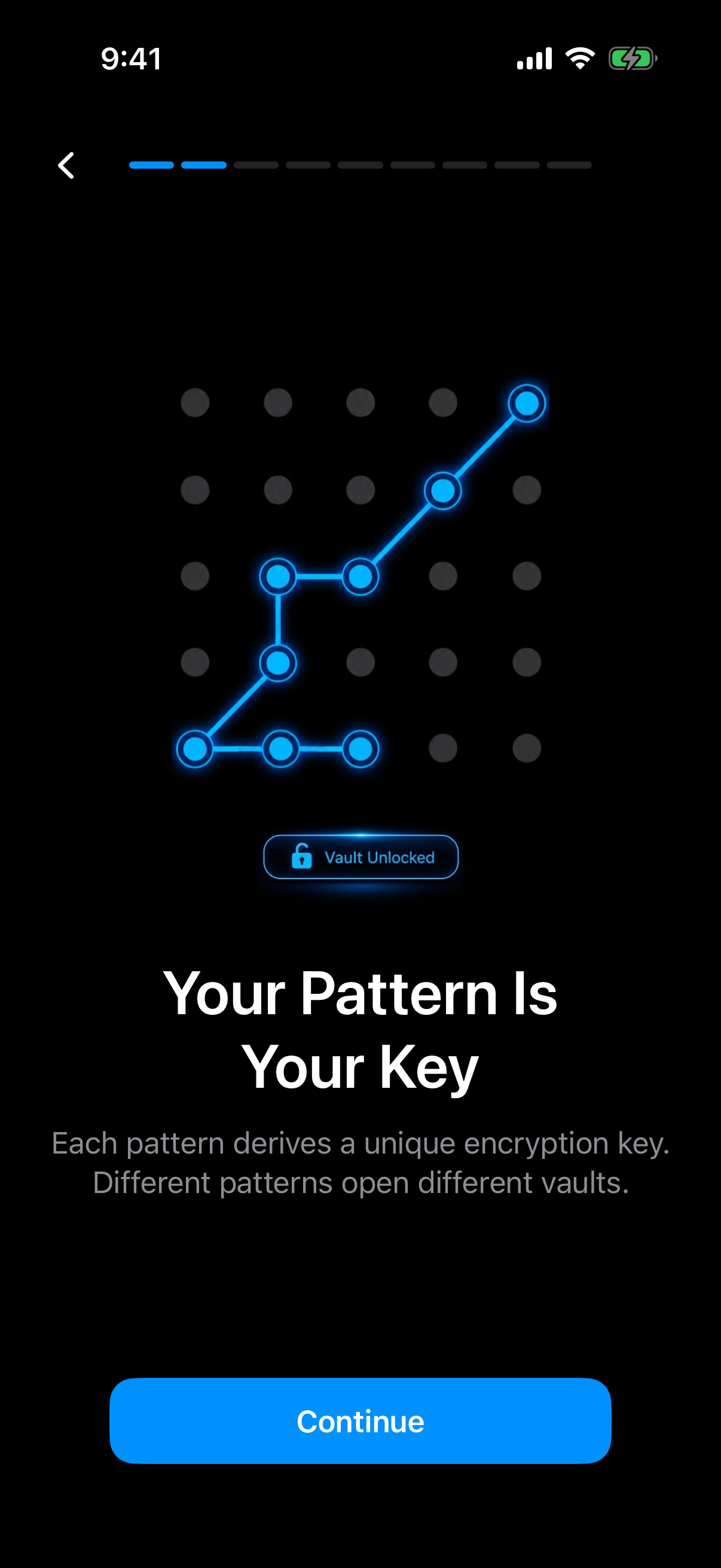
Each pattern derives its own encryption key, and different patterns open different vaults.
Pricing: subscription vs. lifetime option
Vaulty's published pricing, per its App Store listing, is subscription-only: plans run from $7.99 weekly up to $99.99 yearly, with separate premium tiers layered on top. There's no lifetime purchase option listed — the pricing structure is ongoing, recurring payment.
weavevault.app's structure is different, and it's worth being precise rather than making it sound better than it is. The free tier is genuinely usable but limited: 3 vaults, 50 files per vault. Enabling cloud backup requires Pro — that part isn't free, and it never has been. What is worth knowing is what still works if Pro lapses: restoring an existing backup never requires Pro, and browsing or exporting your files keeps working even without an active Pro subscription. Pro itself is available as a monthly or annual subscription (with a 7-day trial) or as a one-time lifetime purchase — Vaulty offers no equivalent one-time option.
So the real difference isn't "free vs. paid" — both apps eventually ask you to pay for backup. It's that weavevault.app gives you a way to pay once and be done, and it doesn't lock you out of files you've already backed up if you stop paying.
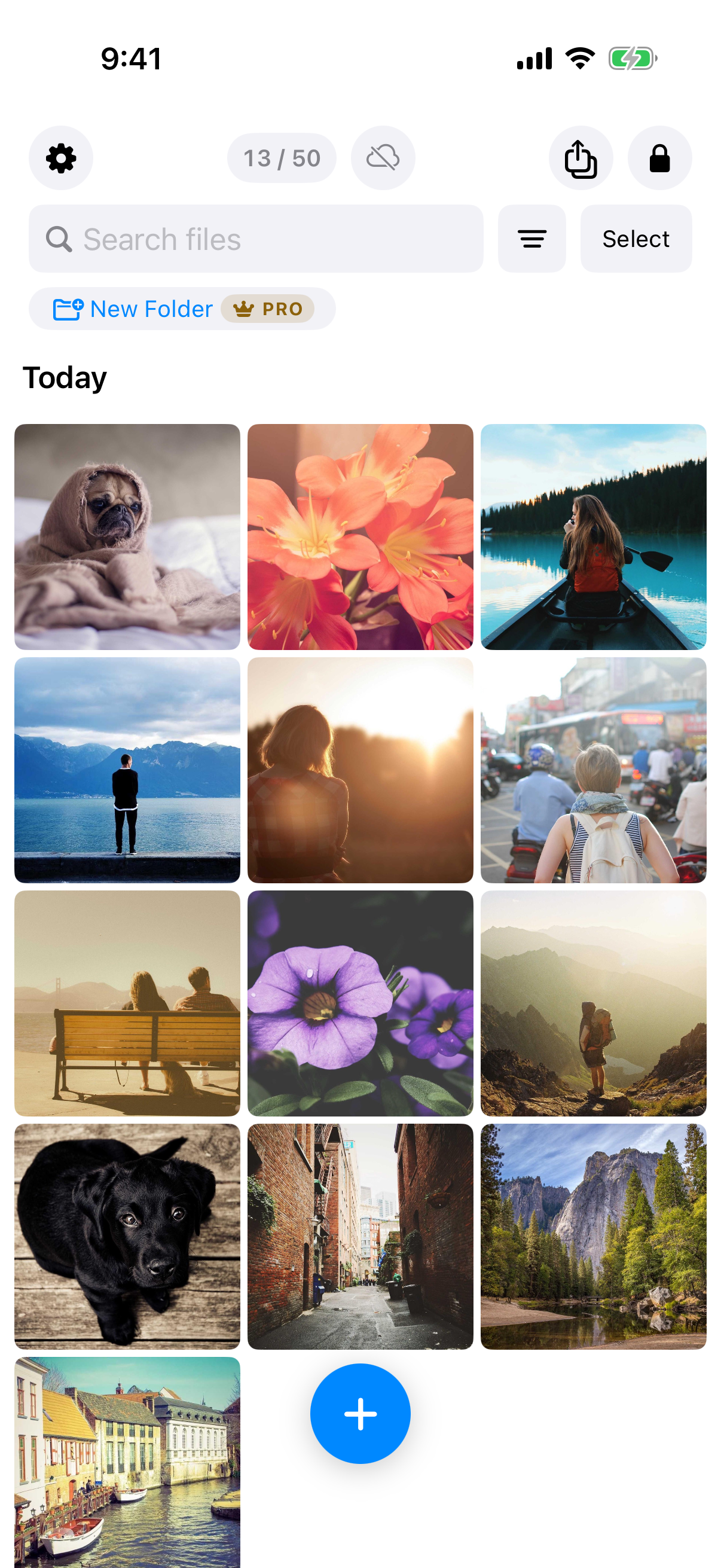
The free tier counts files against a 50-file limit per vault.
Verdict
Choose weavevault.app if what matters most is having nothing to hand over before you can start: no email, no profile, no account of any kind, on free or paid. It also matters if you want your cryptography spelled out rather than implied — AES-256-GCM per file, Argon2id key derivation at published RFC 9106 parameters — and if you'd rather pay once for Pro than commit to an open-ended subscription.
Choose Vaulty if the features it kept from the Vaulty Stocks era matter more to you than an account-free model. Vaulty's front-camera "mugshot" feature, which photographs anyone who enters the wrong unlock code, is a real deterrent that weavevault.app's verified feature set doesn't currently include. The same goes for Vaulty's disguised app icons — modes that make the app look like a stock market ticker, Notes, or Passwords on your home screen — which weavevault.app also doesn't offer. If either of those specifically is why you liked Vaulty Stocks, and you're comfortable with an email-linked account and a subscription, Vaulty is the honest recommendation, not weavevault.app.